
Are You Compliant? The IRS Definition of Tax Compliance
Unpacking IRS Tax Compliance: What You Need to Know

Understanding IRS tax compliance means knowing how to meet your tax duties under the rules set by the Internal Revenue Service. It's all about making sure you follow tax laws.
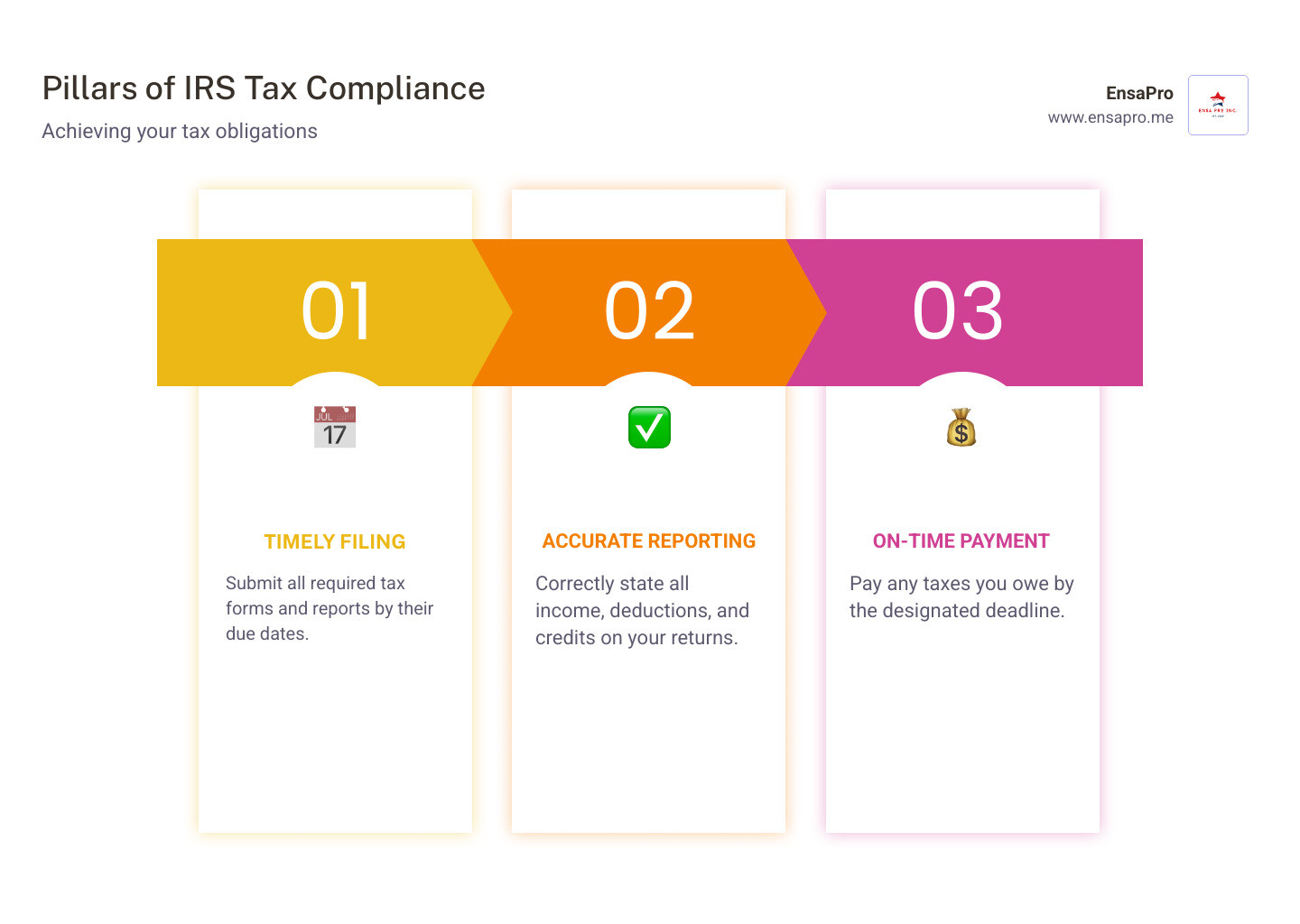
Simply put, it involves three main pillars:
- Timely Filing: This means submitting all your required tax forms and reports by their due dates.
- Accurate Reporting: You need to make sure all your income, deductions, and credits are correctly stated on your returns.
- On-Time Payment: Any taxes you owe must be paid by the deadline.
Doing this helps you avoid penalties and keep your finances healthy.
For individuals and businesses, tax compliance is crucial. It protects you from fines, interest charges, and potential legal issues with the IRS. It also helps you maintain financial stability and peace of mind. We'll guide you through what this truly means and how to achieve it.
What is IRS Tax Compliance and Why Does It Matter?
At its core, IRS tax compliance is the process of following IRS regulations to accurately report your income, expenses, and pay the correct amount of taxes you owe. This doesn't just apply to federal taxes; it extends to state and local tax obligations as well. For us, this means adhering to all federal tax laws and, where applicable, the tax requirements set by the state of California.
The importance of IRS tax compliance cannot be overstated for individuals and businesses alike. It's the bedrock of our financial system, ensuring that public services are funded and that everyone pays their fair share. The IRS itself views voluntary compliance as the foundation of the U.S. tax system, with approximately 85% of taxes paid voluntarily and on time.
For you, the taxpayer, it ensures legality, helps you avoid severe penalties, and maintains your financial health. Non-compliance, on the other hand, can lead to a host of unpleasant consequences:
- Penalties: These can range from late filing penalties to accuracy-related penalties, significantly increasing your tax burden.
- Interest Charges: The IRS charges interest on underpayments, which can accrue over time, making your debt grow larger.
- Audits: Non-compliance can trigger an examination of your tax returns, which can be a time-consuming and stressful process.
- Legal Action: In severe cases of tax evasion or fraud, the IRS can pursue criminal investigations, leading to potential prosecution. For instance, in FY 2024, the IRS completed 2,481 criminal investigations.
Maintaining good IRS tax compliance is not just about avoiding trouble; it's about contributing to a fair system and securing your own financial well-being.
The Three States of Compliance
When discussing IRS tax compliance, it's helpful to understand how the IRS categorizes a taxpayer's status. This is often summarized in what's called a tax compliance report, which we'll dig into shortly. Generally, there are three main states:
- Compliant: This is the ideal state. It means you have met all your tax obligations in good faith. You've filed all required tax returns accurately and on time, and you've paid all your taxes when they were due. There are no overdue returns or unpaid tax debts.
- Noncompliant: This status indicates that you currently have outstanding tax obligations. This could mean you have overdue tax returns that haven't been filed, or you have an unpaid tax debt as of the date the report was generated.
- Compliance Issue: This status falls somewhere in between. It suggests that while you might be actively working to resolve a tax matter, there's still an ongoing issue. Examples include paying a balance due through an installment agreement, having a history of late payments or late filings, or having a civil tax fraud penalty assessed within the last five years. It could also mean you have a balance under review.
Here's a quick comparison of these three states:
| Status | Definition | Example |
|---|---|---|
| Compliant | All tax returns filed on time, all taxes paid in full, no outstanding debts or issues. | You filed your 2023 federal tax return by April 15, 2024, and paid any taxes owed. |
| Noncompliant | You have overdue tax returns or unpaid tax debts. | You failed to file your 2022 tax return, or you filed it but still owe a balance that has not been paid. |
| Compliance Issue | You are working to resolve a tax obligation, have a history of late payments/filings, or other specific issues. | You have an active installment agreement with the IRS to pay off a tax debt, or you've received a penalty for a fraudulent failure to file in the last five years. |
Understanding Your Tax Compliance Report
The IRS tax compliance report is a valuable document that summarizes your tax filing and payment history, confirming whether you've met your obligations. It’s not just for your peace of mind; employers, federal agencies, and banks may request this report to verify your tax standing.
To obtain your report, the process is straightforward: you can download a copy directly from your individual online account or business tax account on the IRS website. We recommend creating an IRS account if you don't already have one, as it provides a secure portal to access your tax records, view payments, and manage various aspects of your tax situation.
The report provides crucial information about your IRS tax compliance status, including:
- Your compliance status: This will be one of the three states we just discussed: Compliant, Noncompliant, or Compliance Issue.
- Filing information: It lists tax returns that have been filed, or not filed, within the past six years.
- Amount you owe: It details any outstanding tax liabilities.
- Additional information: This might include late payments of federal income, employment, or excise taxes for the past four tax years, or any civil tax fraud penalties assessed within the last five years.
It’s important to understand that a IRS tax compliance report is different from a tax transcript. While a tax transcript provides detailed line-by-line information from your actual tax return for a specific year, a compliance report gives you a broader overview of your compliance status over a longer period, without revealing personal income details or filing status. For individuals and sole proprietors, this is often referred to as Letter 6201, while businesses typically use Letter 6575 for federal contracting purposes.
It takes approximately two weeks for payments to post to your account and four to six weeks for returns to post after submission, so factor this into your timing if you need an up-to-date report.
How the IRS Helps and Checks for Compliance
The IRS isn't just about enforcement; it also provides a wealth of resources to help taxpayers understand and meet their obligations. Our goal, and the IRS's, is to make IRS tax compliance as clear and manageable as possible.

One of the most powerful tools at your disposal is your IRS Online Account. Here, you can:
- Access your tax records and transcripts.
- View your payment history and make payments.
- Check the status of your refund using the refund tracker.
- Find forms and instructions.
- Use the Tax Withholding Estimator to ensure you're withholding the correct amount from your paycheck.
Beyond the online account, the IRS offers numerous publications like Publication 4852 (for federal employee compliance) and Publication 594 (explaining the collection process and options for those unable to pay). They also provide the IRS2Go app for mobile access to tax tools.
A key distinction to understand is the difference between an IRS tax compliance check and an audit (or examination). A compliance check is generally a proactive or preliminary review to ensure you've met basic obligations, while an audit is a more in-depth, reactive investigation into the specifics of your tax return.
IRS Tax Compliance Checks Explained
An IRS tax compliance check is a review conducted by the IRS to verify that individuals and businesses have met their fundamental tax obligations. Think of it as a quick health check for your tax situation. As the research notes, it "doesn’t dig into the specifics of tax" but rather confirms that all required tax returns have been filed and that taxes have been paid on time. It also ensures that all necessary information reporting and recordkeeping are in order.
These checks often involve automated systems and can be triggered by discrepancies between the information you report and what third parties (like employers or banks) report to the IRS. Common examples include:
- Automated Underreporter (AUR) Program: This program matches income, deductions, and credits reported on your tax return with data reported by employers (W-2s) and financial institutions (1099s). If there’s a mismatch, you might receive a letter from an IRS Tax Examiner to resolve the discrepancy. In FY 2024, the IRS closed 1.2 million cases under this program, resulting in $7.7 billion in additional assessments.
- Math Error Notices: These are sent when the IRS identifies simple mathematical errors or mismatches of taxpayer information on your filed return that would result in a tax change. These are typically easy to resolve.
- Automated Substitute for Return (ASFR) Program: If you haven't filed a required income tax return, the IRS might use information from third parties to create a substitute return for you and assess tax, interest, and penalties. This program aims to encourage non-filers to file their own, more complete returns. In FY 2024, the IRS closed 442,633 cases under this program.
These checks are typically less intrusive and burdensome than a full audit, often resolved through correspondence without a review of your books and records.
When a Check Becomes an Examination (Audit)
While a compliance check is a surface-level review, an audit, or examination, is a deeper dive into your tax return to determine if income, expenses, and credits are being accurately reported. Audits are a critical tool the IRS uses to detect noncompliant activity.
Several factors can trigger an audit, including:
- Discrepancies: If the IRS's automated systems flag unusual deductions, high income relative to reported expenses, or inconsistencies with industry averages.
- Third-Party Information: Information received from employers, banks, or other sources that doesn't match your return.
- Random Selection: Some returns are selected randomly as part of the National Research Program (NRP) to measure voluntary compliance and identify common non-compliance patterns.
There are three main types of IRS examinations:
- Correspondence Examinations: These are the most common type, conducted entirely through the mail. They typically focus on one or two specific issues, such as verifying deductions or credits (e.g., a request for tuition receipts for the Lifetime Learning Credit).
- Office Examinations: These involve face-to-face interaction, usually conducted at an IRS office. They are generally broader than correspondence exams but less complex than field exams, often handled by Tax Compliance Officers (TCOs).
- Field Examinations: These are the most comprehensive and are typically conducted at your home, business, or your representative's office. They are reserved for more complex returns, often involving businesses or high-income individuals, and are handled by Revenue Agents (RAs). These can involve multiple tax years and related entities. For example, the exam coverage rate for individual taxpayers reporting total positive income of $10 million or more was 11.0% for Tax Year 2019.
During an audit, you have specific taxpayer rights, including the right to representation and the right to request a review by the Independent Office of Appeals if you disagree with the auditor's findings.
From Soft Letters to Audits: IRS Compliance Actions Explained
The IRS employs a wide spectrum of tools to encourage IRS tax compliance, always aiming to balance the burden on the taxpayer with the potential benefit of the compliance effort. As an IRS Deputy Commissioner noted, audits are just one piece of the puzzle; the IRS has many additional tools to support fairness in the nation's tax system.
These tools range from gentle nudges to serious investigations:
- Educational and "Soft" Letters: These are often proactive communications. The IRS might send an educational letter informing you about tax benefits you might be eligible for (like the Earned Income Tax Credit) or a "soft" letter reminding a foreign corporation of its potential obligation to file Form 1120-F if no return has been filed. These are designed to educate and prevent non-compliance before it occurs.
- Formal Notices: Beyond math error notices, these are more direct communications regarding specific issues, often asking for more information or proposing changes to your return.
- Compliance Checks: As discussed, these are reviews to ensure basic filing and payment requirements are met, without digging into your books and records. An example might be checking if a business that indicated it has employees has filed Form 940 (federal unemployment tax).
- Automated Underreporter (AUR) and Automated Substitute for Return (ASFR) Programs: These are automated compliance actions that don't require a review of your books but can lead to adjustments or the creation of a return on your behalf.
- Audits (Examinations): These are the more in-depth reviews requiring you to provide records to substantiate your tax return entries.
- Criminal Investigations: These are reserved for cases of suspected intentional tax fraud, evasion, or other financial crimes. The IRS Criminal Investigation (CI) function works with the Department of Justice to investigate and refer cases for prosecution. These are serious matters, focusing on illegal-source financial crimes, narcotics-related financial crimes, and legal-source tax crimes.
The IRS uses these tools strategically. For example, returns claiming the Earned Income Tax Credit (EITC) are frequently subject to correspondence exams due to a historical annual error rate of approximately 25%, resulting in improper payments of over $17 billion per year. These exams are often completed within months. Conversely, higher-income taxpayers face more complex, in-person field examinations conducted by experienced teams, which can take years.
The People Behind Compliance: Officers and Programs
Ensuring IRS tax compliance requires a dedicated team of professionals. When you interact with the IRS regarding a compliance matter, you might encounter different types of officers, each with a specific role:
- Tax Examiners (TEs) and Tax Compliance Officers (TCOs): These individuals typically handle less complex issues, such as correspondence audits or office examinations. They review financial records, assess tax liabilities, and work with taxpayers to resolve discrepancies. They also provide education and guidance on maintaining proper records.
- Revenue Agents (RAs): These are experienced auditors who conduct more complex field examinations, often for businesses or high-income individuals. Their work can involve in-depth analysis of financial statements and business operations.
- Revenue Officers (ROs): These officers are responsible for collecting delinquent taxes. If you have an unpaid tax debt, an RO might contact you to arrange a payment plan or discuss collection alternatives.
- Criminal Investigation Special Agents: These agents investigate potential criminal violations of tax laws and related financial statutes, such as tax fraud and money laundering.
The broader IRS compliance program is a proactive approach to ensuring tax laws are followed. One key part of this program, particularly for large corporate taxpayers, is the Compliance Assurance Process (CAP). CAP is designed to resolve tax issues in real-time, before tax returns are even filed. While this specific program is for large corporations, the principle of proactive engagement and real-time resolution is something we encourage for all our clients, regardless of size.
Special Considerations: Federal Employees and High-Income Earners
Certain groups face particular scrutiny regarding IRS tax compliance.
Federal Employees: Federal employees have a unique obligation to uphold the law, and that includes their tax responsibilities. Regulation 5 CFR § 2635.809 from the Office of Government Ethics explicitly states that federal employees must "satisfy in good faith their obligations as citizens, including all just financial obligations, especially those such as federal, state or local taxes that are imposed by law."
Federal managers also play a vital role in ensuring employee tax compliance. They are encouraged to discuss tax filing and payment obligations with their employees and to use resources like IRS publications to help employees understand their responsibilities. This ensures integrity within government and maintains public confidence.
High-Income Earners: The IRS has significantly ramped up its enforcement efforts against high-income earners, large corporations, and complex partnerships. This focus is driven by the understanding that a substantial portion of the estimated $600 billion tax gap comes from these segments. The IRS is leveraging advanced data analytics and artificial intelligence to identify potential noncompliance more effectively in these areas.
Recent enforcement efforts have yielded results: the IRS collected $122 million from 100 cases involving high-income earners with over $1 million in income and more than $250,000 in recognized tax debt. The IRS plans to increase audit rates on wealthy individuals (with total positive income over $10 million) by more than 50% and double audit rates on taxpayers with assets over $250 million. Our firm often works with clients in these brackets, providing expert guidance to steer complex tax structures and ensure robust IRS tax compliance.
The Future of Enforcement: AI, Data, and Your IRS Tax Compliance
The IRS is undergoing a significant change, heavily leveraging technology and data analytics to improve IRS tax compliance and enforcement. This modernization is a generational imperative, aiming for a future where all taxpayers can meet their responsibilities digitally and noncompliant taxpayers pay what they owe.

- Advanced Data Analytics and Artificial Intelligence (AI): The IRS is investing heavily in expanding its data and analytics capabilities. This means using sophisticated algorithms to analyze vast amounts of taxpayer data, identify patterns of potential noncompliance, and optimize case selection for audits and other enforcement actions. This "Advanced Compliance Analytics" allows the IRS to be more precise and effective in its efforts, focusing resources where they are most needed.
- Modernizing IT Systems: To support these advanced capabilities, the IRS is working to modernize its foundational IT infrastructure. This includes Business Systems Modernization (BSM) efforts and digitalization initiatives aimed at creating a "Taxpayer 360" view, where employees have integrated access to taxpayer data, and taxpayers can interact with the IRS digitally. This helps streamline processes and ensures data accuracy.
- The Goal: Narrowing the Tax Gap: The ultimate objective of these technological advancements is to narrow the tax gap, which is the difference between taxes owed and taxes paid on time. With an estimated tax gap of over $600 billion, the IRS is using technology to make the system fairer and ensure everyone contributes their share. This also enables the IRS to improve taxpayer services, with call center service levels increasing to 88% in 2024 and average wait times reduced to just 3 minutes.
This technological evolution means that maintaining strong IRS tax compliance is more critical than ever. The IRS's ability to detect inconsistencies and non-compliance is growing, making proactive and accurate tax management essential for every taxpayer.
Frequently Asked Questions about IRS Tax Compliance
What is the fastest way to check my compliance status?
The quickest method is to log into your individual or business online account on the IRS website. From there, you can view your Tax Compliance Report, which provides a summary of your status.
What should I do if I receive a notice from the IRS?
Do not ignore it. Read the notice carefully to understand the issue and the deadline for response. Gather any requested documents. If you disagree or are unsure how to proceed, it is best to seek professional tax assistance to ensure you respond correctly and protect your rights.
Can I be compliant if I am on an IRS payment plan?
If you are on a formal Installment Agreement with the IRS to pay off a tax debt, your Tax Compliance Report will likely show a "Compliance Issue" status. While you are taking steps to resolve your debt, you are not considered fully "Compliant" until the debt is paid in full.
Conclusion
Navigating the complexities of IRS tax compliance might seem daunting, but it is an essential aspect of responsible financial management for everyone. We've explored what IRS tax compliance truly means, from the fundamental pillars of timely filing, accurate reporting, and on-time payment, to the nuances of compliance checks, audits, and the IRS's evolving enforcement strategies.
A proactive approach is key. This involves diligent, regular record-keeping, staying informed about your tax obligations, and understanding the resources available to you. By doing so, you can prevent issues before they arise, avoid penalties, and ensure peace of mind.
At EnsaPro, we understand that achieving robust IRS tax compliance can be intricate, especially with ever-changing tax laws and increased IRS scrutiny. That's why we offer personalized tax preparation services, including a free draft of your tax return, to help you steer these complexities and ensure the best possible outcome. Let us help you achieve peace of mind and financial stability through expert tax planning and compliance services.
Get your free tax return draft and ensure compliance.