
Unlock Tax Perks: Deducting Your Job Search Costs
Understanding Your Job Search Tax Deductions

Job search expenses were once a valuable tax deduction for many Americans actively seeking new employment. However, the Tax Cuts and Jobs Act (TCJA) of 2017 changed the landscape significantly. Here is what you need to know right now:
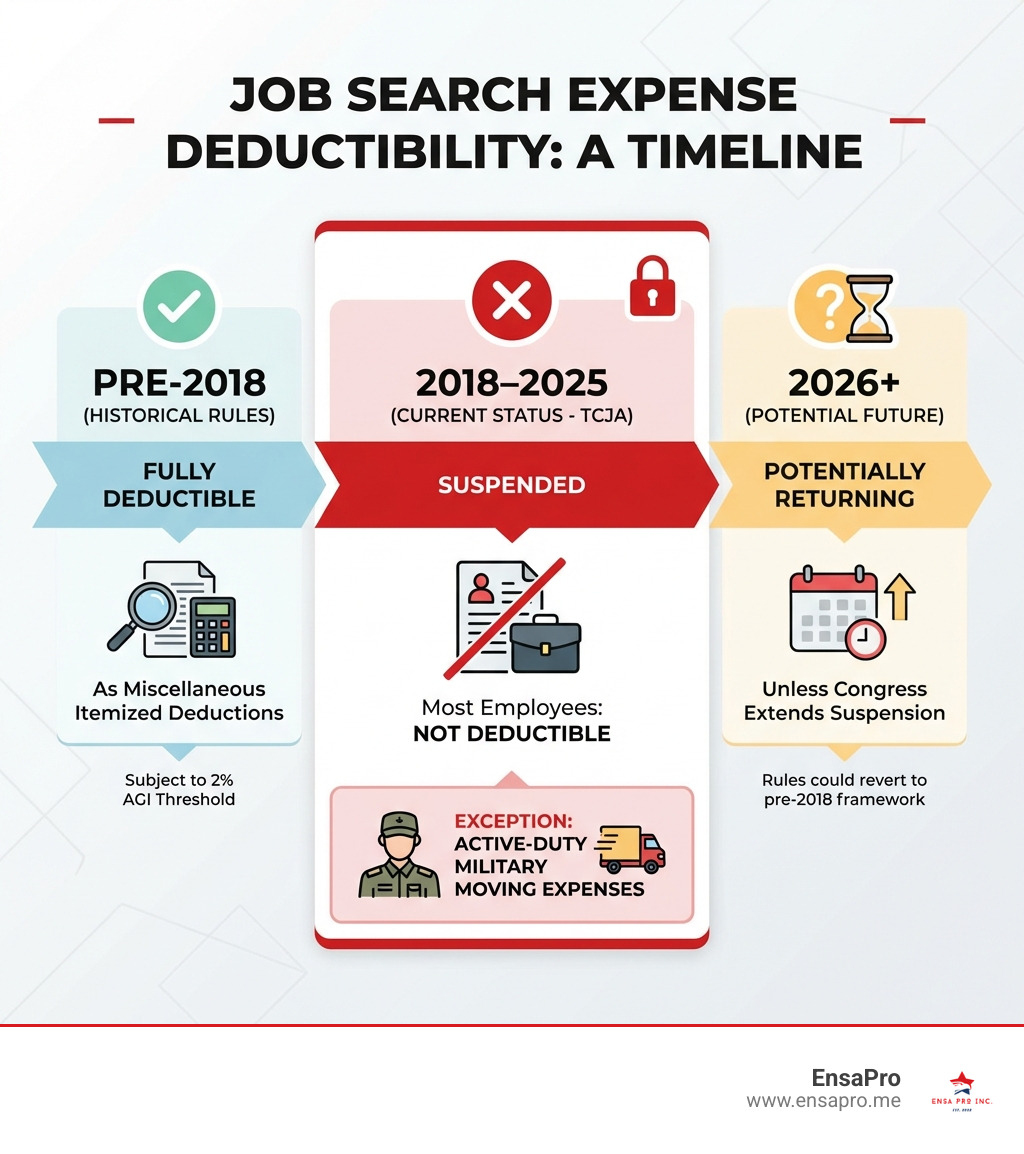
Current Status (2018-2025):
- Job search expenses are NOT deductible for most W-2 employees during tax years 2018 through 2025
- The TCJA suspended miscellaneous itemized deductions, which included job hunting costs
- Exception: Active-duty military members can still deduct certain moving expenses related to a permanent change of station
Historical Rules (Pre-2018) & Potential Future (Post-2025):
- Resume preparation and mailing costs were deductible
- Employment agency fees qualified
- Travel expenses for interviews could be claimed
- You had to search for a job in the same occupation
- You had to itemize deductions and exceed 2% of your Adjusted Gross Income (AGI)
If you are searching for work right now, you might feel frustrated learning that these deductions are temporarily unavailable. The positive side is that understanding these rules can help you plan for the future when the suspension expires in 2026, or if you are filing an amended return for tax years before 2018.
On average, United States job seekers can spend hundreds of dollars per month on job-seeking services, and those costs add up quickly when you are between jobs. Whether you are updating your resume, traveling to interviews, or paying for career coaching, these expenses are real, even if the tax benefits are currently on hold.
The tax landscape around job search costs is more complicated than it needs to be. You deserve clarity about what is deductible now, what might be deductible in the future, and how to keep proper records in case the rules change.
The Current State of Job Search Deductions
As the introduction highlighted, the Tax Cuts and Jobs Act (TCJA) of 2017 brought a significant, although temporary, halt to the deductibility of job search expenses for most U.S. taxpayers. For tax years beginning after December 31, 2017, and before January 1, 2026, miscellaneous itemized deductions that were subject to the 2% adjusted gross income (AGI) limitation were suspended. This category historically included many common job-hunting costs.
What does this mean right now, especially for those in Irvine, California? It means that if you are a W-2 employee looking for a new job in 2024 or 2025, you generally cannot deduct the costs associated with your job search on your federal income tax return. This suspension applies broadly, impacting individuals across the country.
However, it is important to remember that "temporary" means these rules are set to revert in 2026 unless Congress decides to extend the suspension. This makes understanding the historical rules incredibly valuable, as they are likely to become the future rules. Knowing them now allows you to plan and prepare for potential tax benefits when they return.
For those who might be looking back, perhaps filing an amended return for tax years prior to 2018, the old rules still apply. If you incurred job search expenses before the TCJA took effect, and you meet the necessary criteria, you might still be able to claim those deductions.
While federal tax law currently suspends these deductions, state tax laws can sometimes differ. It is always a good idea to consult the California Franchise Tax Board (FTB) or a qualified tax professional for specific guidance on state tax deductions, as local rules in Irvine might have unique provisions. However, the federal suspension is the primary factor to consider for most taxpayers.
Who Is Eligible to Deduct Job Search Expenses?
Even though the deduction for job search expenses is currently suspended, it is useful to understand the eligibility criteria that applied historically and are expected to apply again in 2026. These rules determine who could claim these deductions and under what circumstances.
The "Same Occupation" Rule
One of the most fundamental requirements for deducting job search expenses was the "same occupation" rule. You could only deduct expenses if you were looking for a job in your current line of work, or a field substantially similar to it.
For instance, if you were a software engineer looking for another software engineering position, your related expenses would likely be deductible (assuming all other criteria were met). However, if you were a teacher deciding to change careers and become a nurse, the expenses incurred during your job search for a nursing position would not be deductible. The IRS views this as seeking employment in a new field, which does not qualify.
This rule means that career changers, no matter how passionate or determined, were generally ineligible to deduct their job search expenses. As tax lawyer David Hryck notes, "you can do so only if you are looking for a job within your current profession."
Continuity of Employment
The IRS also had rules around your employment history when it came to deducting job search expenses.
- First-time job seekers: If you were looking for your very first job, perhaps as a graduating student from a university in Irvine, you could not deduct any associated expenses. The rationale is that tax deductions are generally for expenses incurred while carrying on a trade or business, and if you have not worked before, you have not established that trade or business.
- Substantial break in employment: Similarly, if there was a substantial break between your last job and the time you started looking for a new one, your job search expenses would typically not be deductible. The IRS does not explicitly define what constitutes a substantial break, leaving some ambiguity, but it is generally understood to mean a significant period of unemployment where you were not actively engaged in your profession.
- Unemployed individuals: If you were unemployed but actively looking for work in your same field without a substantial break, your expenses could still be deductible. The key was the continuity of your professional pursuit, even if you were not currently employed.
The 2% AGI Threshold
Even if you met the "same occupation" and "continuity of employment" rules, there was another hurdle: the 2% Adjusted Gross Income (AGI) threshold. Historically, job search expenses were classified as miscellaneous itemized deductions.
To claim these deductions, you first had to itemize your deductions on Schedule A of your Form 1040. Many taxpayers choose the standard deduction because it is simpler and often larger than their total itemized deductions. But if your itemized deductions (including your job search expenses) exceeded the standard deduction, then itemizing could save you money.
However, even within itemized deductions, miscellaneous expenses like job search costs were only deductible to the extent they exceeded 2% of your adjusted gross income. For example, if your AGI was $50,000, the first $1,000 (2% of $50,000) of your miscellaneous itemized deductions would not be deductible. Only the amount above that $1,000 threshold would count toward your total itemized deductions. This threshold often meant that only those with significant job search expenses or other miscellaneous deductions would see a tax benefit.
A Breakdown of Potentially Deductible Job Search Expenses
While we steer the temporary suspension of these deductions, it helps to look at the types of job search expenses that were historically deductible and are likely to be so again. Knowing what counts can help you carefully track these costs now, so you are ready when the rules change.
Think of it this way: if you are spending money to get a new job, and it is in your current line of work, there is a good chance it would have been deductible. Here is a list of common expenses:
- Resume preparation and distribution: This includes costs for professional resume writers, printing multiple copies, and postage for mailing applications. As tax experts point out, "You can deduct amounts you spend for preparing and mailing copies of your resume to prospective employers as long as you meet the other requirements."
- Employment and outplacement agency fees: If you paid a headhunter or an agency to help you find a new position, those fees were typically deductible.
- Career counseling and coaching: Fees paid to career coaches or counselors to help refine your job search strategy or interview skills could also be included.
- Attending career fairs: The costs associated with attending career fairs, such as admission fees, were deductible.
- Telephone and internet expenses: A portion of these costs directly attributable to your job search (for example, specific long-distance calls for interviews, dedicated internet usage for job applications) could be deducted.
- Transportation expenses: This covers travel to interviews, career fairs, or an employment agency.

Travel Costs for Your Job Search
Travel expenses are often a significant part of job search expenses, especially if you are looking for opportunities beyond Irvine. The key here was the "primary purpose rule."
- Main purpose rule: You could deduct travel expenses if the primary purpose of your trip was to look for a new job in your existing line of work. This included transportation costs (airfare, train tickets, car mileage), lodging (hotel stays), and even meals (subject to a 50% limit). For instance, if you flew from Los Angeles to San Francisco specifically for job interviews, those travel costs would typically be deductible.
- Incidental job searching: Even if job searching was not the main purpose of a trip, some costs directly related to job hunting during that trip could still be deductible. For example, if you were on a personal vacation but took a day to attend an interview, the specific costs for that interview day (such as local transportation or a meal during the interview) might be deductible. However, the travel to and from the vacation destination itself would not be.
- Local travel: Daily travel within your local area (like driving from your home in Irvine to an interview in Orange County) was also deductible, typically at the standard mileage rate set by the IRS.
Commuting to your current job is never deductible, but traveling to find a new job in your field is treated differently.
What About Employer Reimbursements?
One simple rule to remember for any expense, including job search expenses, is this: if someone else pays for it, you generally cannot deduct it.
If a prospective employer or your former employer reimbursed you for any job search expenses, those reimbursed amounts were not deductible by you. For example, if a company flew you out for an interview and paid for your flight and hotel, you could not then claim those costs as a deduction.
There is also a specific scenario involving employment agency fees. If you paid an employment agency fee, deducted it in one year, and then your new employer reimbursed you for that fee in a later year, you would generally need to include the reimbursed amount in your gross income in the year you received it, up to the amount of the prior year's tax benefit. This prevents a double benefit.
How to Claim the Deduction and Keep Proper Records
For those considering amending pre-2018 tax returns or planning for the potential return of these deductions in 2026, understanding the claiming process and the necessity of good record-keeping is vital.
Historically, job search expenses were claimed as miscellaneous itemized deductions on Schedule A of your Form 1040. While a separate form, Form 2106 (Unreimbursed Employee Expenses), was sometimes used to calculate these and other unreimbursed employee expenses, the final deductible amount was transferred to Schedule A.
The process of itemizing deductions means you list out specific expenses to reduce your taxable income, rather than taking the simpler standard deduction. This only makes sense if your total itemized deductions exceed the standard deduction amount for your filing status.
Essential Record-Keeping for Your Job Search Expenses
Effective record-keeping is your best support when it comes to tax deductions. The IRS requires documentation to support any deduction you claim. Without it, your deduction could be disallowed if your return is reviewed. For job search expenses, this means keeping:
- Receipts: For every expense, from resume printing to hotel stays. Make sure receipts clearly show the vendor, date, amount, and what was purchased.
- Mileage logs: If you used your personal vehicle for job-related travel, a detailed log showing dates, destinations, purpose of travel, and miles driven is crucial. This is particularly important for those commuting within Irvine and surrounding areas for interviews.
- Invoices and statements: For services like professional resume writing, career coaching, or employment agency fees, keep the invoices and records of payment.
- Credit card and bank statements: These can help corroborate your expenses, especially if a receipt is lost, but they typically are not sufficient on their own.
- Travel itineraries: For long-distance job search trips, keep records of your travel plans, including flight or train tickets and hotel confirmations.
- Proof of job search activity: While not directly an expense, keeping records of job applications, interview invitations, and correspondence can help demonstrate that you were actively searching for a job in your field.
The IRS provides guidance on what constitutes a miscellaneous deduction in Publication 529, Miscellaneous Deductions. This publication is a useful resource for detailed information and can help you understand the nuances of what is and is not deductible.
Frequently Asked Questions about Job Search Costs
It is natural to have questions about something as complex as tax deductions, especially when the rules change. Below are answers to some common queries about job search expenses and related topics.
Can I deduct moving expenses for a new job?
This is a common concern, and moving expenses have faced similar treatment to job search expenses under the TCJA. For most taxpayers, the deduction for moving expenses was also suspended from 2018 through 2025. This means if you moved for a new job in Irvine, California, or elsewhere during this period, you generally cannot deduct those costs on your federal tax return.
However, there is an important exception: Active-duty members of the U.S. Armed Forces who move due to a permanent change of station can still deduct their unreimbursed moving expenses. This exception was specifically retained in the TCJA.
Historically (pre-2018) and potentially in the future (post-2025), moving expenses were deductible if you met two main tests:
- The Distance Test: Your new workplace had to be at least 50 miles farther from your old home than your old workplace was from your old home. So, if your old job was 5 miles from your old home, your new job would need to be at least 55 miles from your old home.
- The Time Test: You generally had to work full-time at your new job for at least 39 weeks during the 12 months immediately following your move.
These historical rules are important to remember, as they illustrate the conditions that might apply again in 2026.
What if I do not end up getting a new job?
Historically, you did not have to land a new job to deduct your job search expenses. The deductibility was based on the effort and the expenses incurred during your search, not on its success.
So, if you met all the eligibility criteria (searching in your same occupation, no substantial break, not a first-time job seeker) and kept detailed records, you could claim the deduction even if your job search efforts did not immediately result in new employment. This principle is likely to hold true if the deduction returns after 2025. It is about being actively engaged in finding work in your established field.
Are costs for looking for my very first job deductible?
No. Costs for looking for your very first job have never been deductible, and this rule is unlikely to change. The IRS views job search expenses as costs incurred while carrying on a trade or business. If you are a first-time job seeker, you have not yet established yourself in a trade or business.
This means graduating students, or anyone entering the workforce for the first time, cannot deduct expenses like resume writing, interview travel, or career fair fees. The same applies if you have been out of the workforce for a very long time and are essentially starting fresh.
Get Expert Help with Your Tax Deductions
The world of tax deductions, especially for something as personal as job search expenses, can feel like navigating a maze. With the temporary suspension of these deductions under the TCJA, and the potential for their return in 2026, staying informed is more crucial than ever. The complexity of tax law, with its thresholds, exceptions, and changing regulations, often requires a keen eye and expert knowledge.
You may want to maximize your tax benefits and ensure you are compliant with all IRS rules, whether you are looking back at pre-2018 filings or planning for the future. That is where professional guidance becomes invaluable.
At EnsaPro, we specialize in providing personalized tax preparation services, helping individuals in Irvine, California, steer these intricate rules. Our thorough and personalized approach means we take the time to understand your unique situation, ensuring that every eligible deduction and credit is considered. We aim to achieve the best possible outcome for your tax situation, so you can focus on your career and future.
Do not let the complexities of tax law leave you guessing. You can get support from experts who follow the latest IRS guidance and California rules. EnsaPro even offers a free, no-obligation tax return draft so you can see the potential savings for yourself.
Get your free tax return draft and consultation today, and let us help you open up the tax perks you deserve.