
Tax Second Opinion: How to Double-Check Your Return for Peace of Mind
Why Getting a Second Opinion on Taxes Before Filing Matters

A second opinion on taxes before filing can be the difference between leaving money on the table and maximizing your refund. Whether you prepared your return yourself or worked with a tax professional, a fresh set of expert eyes can catch errors, identify missed deductions, and give you confidence that you're not overpaying.
Quick Answer: How to Get a Tax Second Opinion
- Gather your prepared tax return (even if not yet filed) and supporting documents
- Find a qualified tax professional (CPA, EA, or tax attorney) different from your original preparer
- Request a full review of your federal and state returns for errors and missed opportunities
- Review the findings and decide whether to file as-is or make corrections
- File an amended return (Form 1040-X) if errors are found, within three years of the original filing date
Why consider this extra step? Tax laws change every year, and even small mistakes can be costly. In one case documented by tax professionals, a missed alimony deduction cost a taxpayer $55,000. Common errors include incorrect filing status, unclaimed tax credits, missed deductions, and forgotten carryforwards from previous years.
A second opinion isn't about distrust—it's about protecting your financial health. The IRS doesn't catch every mistake, and some errors can trigger audits, penalties, or leave you paying more than you owe. The cost of a review is typically far less than the potential savings or penalties avoided.
Think of it like getting a second medical opinion before surgery. Your taxes deserve the same careful attention.
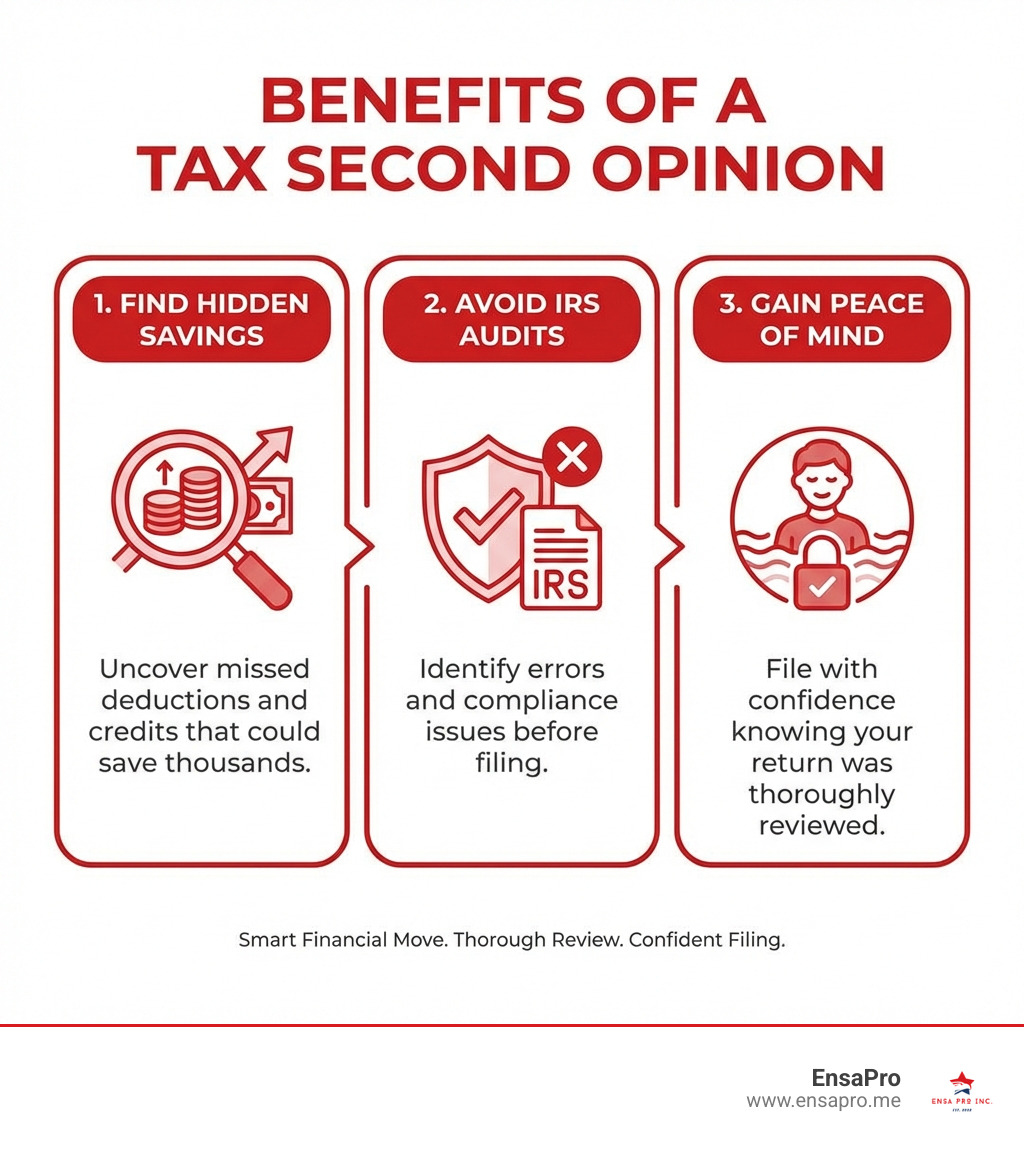
Why a Second Opinion on Your Tax Return is a Smart Financial Move
When it comes to our finances, especially our taxes, we often walk a tightrope between wanting to save money and ensuring we stay compliant with the law. For many, tax preparation feels like a necessary evil, a chore to get through as quickly and painlessly as possible. But what if we told you that a little extra diligence could lead to significant financial benefits and immense peace of mind? That's where a second opinion on taxes before filing comes in.
Getting a professional review of your tax return isn't just about double-checking numbers; it's about ensuring you're taking full advantage of every legal opportunity to reduce your tax liability. It’s a proactive measure, a financial health check that can save you thousands of dollars and prevent future headaches.

Consider this: in some cases, we've found thousands in missed deductions, incorrect filing statuses, or opportunities for amended returns that paid off big. The financial risk of a critical error on a tax return can far exceed the cost of a second opinion. It's a small investment that could lead to significant savings. This proactive approach is why many tax experts agree that it's better to get a tax opinion before filing, rather than waiting until you're facing an audit.
The Value of a Fresh Perspective
Even if you're confident in your original tax preparer or your own DIY skills, a fresh set of expert eyes can uncover missed opportunities. We all have blind spots, and tax law is complex enough to have many hidden corners. A second opinion can:
- Uncover missed opportunities: Many taxpayers overpay because they aren't aware of eligible deductions and credits that could reduce their tax bill. For instance, a review might reveal you qualify for an education credit you didn't know about, or that you missed a carryforward from a previous year.
- Ensure compliance: Beyond saving money, a second opinion helps identify potential errors or compliance issues that could flag your return for an IRS audit. It's about making sure everything is structured correctly and that you're minimizing your audit risk.
- Catch overlooked deductions and credits: This is where the real savings often lie. From business expenses to specific life event-related credits, a seasoned professional can spot what might have been overlooked.
- Act as an investment for savings: The fee for a second opinion is typically a fraction of what you could potentially save or avoid in penalties. It’s an investment in your financial well-being.
The Impact of Evolving Tax Laws
Tax laws are constantly changing. What was accurate last year might be costing you thousands now. This annual evolution makes expert guidance invaluable.
- Annual law changes: Every year, new legislation, amendments, and IRS rulings can dramatically alter the tax landscape. Keeping up with these changes is a full-time job, which is why professional preparers spend countless hours in continuing education.
- New credits and deductions: With changes come new opportunities. You might qualify for a credit or deduction that didn't exist, or that you didn't meet the criteria for, in previous years. A second opinion can ensure you don't miss these.
- Outdated strategies: A tax strategy that was perfectly valid a few years ago might now be suboptimal or even incorrect due to law changes. A second review can help you adapt.
- Professional guidance: For us, understanding these shifts is part of our commitment. We assess how these changes impact your unique situation, ensuring your return reflects the most current and beneficial strategies available.
When to Consider Getting a Second Opinion on Your Tax Return
Knowing when to seek a second opinion on taxes before filing is crucial. It’s not just for those who suspect errors, but also for those whose financial lives have changed significantly or who simply want an extra layer of assurance.

Here's a list of key scenarios that should trigger a tax review:
- After Major Life or Financial Changes: Significant shifts in your personal or financial life almost always have tax implications.
- If Your Tax Outcome is Unexpected: When your refund or tax liability deviates wildly from what you anticipated, it's a strong signal for a review.
- If You Have Doubts About Your Tax Preparer: Trust and thoroughness are paramount in tax preparation. If either is lacking, a second opinion is warranted.
After Major Life or Financial Changes
Life is dynamic, and your tax situation rarely stays the same year after year. Major life events can dramatically alter your tax picture, making a second opinion incredibly valuable.
- New business: Starting a business, whether it's a full-time venture or a side hustle, introduces a whole new layer of tax complexity. Deductible expenses, self-employment taxes, and entity structure all need careful consideration. A review ensures you're optimizing for your new venture.
- Marriage or divorce: Your filing status, deductions, and credits can change significantly. For instance, determining whether to file "Married Filing Jointly" or "Married Filing Separately" can have a substantial impact on your overall tax bill. Divorce agreements, especially those related to alimony, also have specific tax implications (though alimony is generally no longer deductible for agreements made after 2018, older agreements are grandfathered in).
- Buying a home: Homeownership brings new deductions like mortgage interest and property taxes. Ensuring these are correctly claimed can lead to significant savings.
- Significant investments: Engaging in substantial stock market activity, real estate investments, or other complex financial endeavors can generate capital gains, losses, and various forms of income that need precise reporting.
- Inheritance: Receiving an inheritance can have estate tax or income tax implications, depending on the assets and the state. A review can help steer these complexities.
If Your Tax Outcome is Unexpected
Sometimes, your gut feeling is your best financial advisor. If the numbers on your prepared return don't align with your expectations, it's time for a deeper look.
- Owe much more than usual: If you're suddenly facing a much higher tax bill than in previous years, it could be due to an error, a missed deduction, or a change in tax law that wasn't adequately addressed.
- Refund is much smaller than expected: Similarly, a surprisingly small refund might indicate missed credits or deductions. Many taxpayers overpay because they aren't aware of eligible opportunities.
- Unexpected tax bill: Receiving an unexpected tax bill from the IRS after filing is a definite red flag. A second opinion before filing can help prevent this unwelcome surprise.
- Feeling uncertain: If you simply feel uncertain or uneasy about what was filed on your behalf, trust that feeling. As one source noted, "If something doesn’t feel right about your last tax return, trust your gut—and get a second opinion." Peace of mind is invaluable.
If You Have Doubts About Your Tax Preparer
Your relationship with your tax preparer should be built on trust and transparency. If you find yourself questioning their process or expertise, it's a strong indicator to seek a second opinion on taxes before filing.
- Rushed preparation: Complex tax returns require significant time and attention to detail. If your preparer seems to rush through your return, especially if you have a complicated financial situation, it raises a red flag. As one insight pointed out, if your return is prepared too quickly, it may lack attention to detail and contain mistakes.
- Preparer didn't ask questions: A good tax preparer will ask thorough questions about your life changes, income, and expenses. If your preparer barely asked for details or seemed uninterested in your specific situation, they might have missed crucial information.
- Lack of communication: You should feel comfortable asking questions and understanding your return. If your preparer is unresponsive or can't clearly explain aspects of your return, it's a problem.
- You don't understand the return: You are responsible for the accuracy of your tax return. If you don't understand what you're signing, you shouldn't sign it. A second opinion can help explain the process and ensure you comprehend your obligations and entitlements.
Common Red Flags and Mistakes a Second Opinion Can Uncover
The journey of tax preparation is fraught with potential pitfalls. Even seasoned professionals can make mistakes, and for those preparing their own taxes, the risk is even higher. A second opinion on taxes before filing is designed to catch these common errors and red flags before they become costly problems.
Signs of a Poorly Prepared Return
Sometimes, the signs of a problematic tax return are quite evident, even to the untrained eye. These are the red flags a quality second opinion will immediately spot.
- Very low preparation fee: While no one enjoys paying hefty fees, in tax preparation, you often get what you pay for. Extremely low fees can be a sign of rushed work, lack of expertise, or even outsourced preparation that might compromise data privacy. As one expert stated, "If your income tax return preparation fee is very low, the quality will be very low as well."
- Preparer won't sign return: This is perhaps the most alarming red flag. A tax preparer is legally required to sign the returns they prepare and include their Preparer Tax Identification Number (PTIN). An unsigned return indicates a "ghost preparer" who is trying to avoid accountability. The IRS specifically warns about ghost preparers who don't sign tax returns. You can learn more about this serious issue here: Beware of 'ghost preparers' who don't sign returns.
- Return seems incomplete: Are there missing forms that you know should be there? For business owners, this might mean a missing Schedule C for a single-member LLC, or a basis worksheet for an S Corporation. If you invested in a partnership, you'll expect to see data from your K-1 form included.
- Visible spelling/math errors: Basic errors like these are inexcusable and suggest a general lack of care and attention to detail throughout the entire return.
- No investigation of business accounting: For business owners, your tax preparer should ideally access and review your accounting files (like QuickBooks Online) rather than just accepting a profit and loss statement at face value. Without verifying the underlying numbers, errors can easily flow into your tax return, leading to penalties and increased audit risk.
Common Filing Errors and Missed Opportunities
Beyond the glaring red flags, a second opinion often uncovers more subtle, yet equally costly, errors and missed opportunities.
- Incorrect filing status: This is a common and often expensive mistake. Choosing the wrong filing status, such as "Head of Household" when you don't qualify, can lead to significant tax discrepancies and penalties. For married taxpayers, deciding between "Married Filing Jointly" or "Married Filing Separately" requires careful analysis, as one option can often save thousands over the other.
- Missed education credits: Are you or a dependent pursuing higher education? You might be eligible for valuable credits like the American Opportunity Credit or the Lifetime Learning Credit. These are frequently overlooked.
- Missed child tax credits: For families, credits like the Child Tax Credit or Credits for Other Dependents can significantly reduce your tax liability. Changes to these credits, like those seen in recent tax reforms, mean it’s easy to miss out if you’re not up-to-date.
- Alimony deduction errors: While new divorce agreements (after December 31, 2018) no longer allow for alimony deductions, older agreements are "grandfathered in." If you're paying alimony under an older agreement, this deduction is still valid and can be substantial. We recently detected a $55,000 alimony deduction that was missed on an original tax return—a prime example of a costly oversight.
- Capital loss carryforwards: If you had investment losses in previous years that exceeded the annual deduction limit, you might have capital loss carryforwards. Forgetting to apply these can mean you're paying more tax on capital gains than necessary. Similarly, passive activity losses can also be carried forward.
How to Get a Second Opinion on Taxes Before Filing
Deciding to get a second opinion on taxes before filing is a smart move. But what does the process actually look like, and how do you ensure you get the most out of it? Let's walk through the steps.
What a Professional Tax Review Includes
When you seek a second opinion from a qualified professional, you're not just getting a quick glance at your numbers. You're typically getting a comprehensive review designed to leave no stone unturned.
- Full return analysis: We'll conduct a thorough examination of your most recent federal and state tax returns. This isn't just about the summary pages; it's about diving into every schedule and form. For clients in Irvine, California, this means a detailed review of both your federal obligations and your California state tax return.
- Federal and state review: Many errors occur because federal changes impact state taxes, and vice-versa. Our review covers both to ensure consistency and compliance across all levels.
- Error identification: We carefully look for potential errors, discrepancies, or inconsistencies that could lead to penalties or missed opportunities. This includes checking for incorrect filing statuses, mathematical errors, and miscategorized income or expenses.
- Audit risk assessment: We'll evaluate your return for any "red flags" that might increase your chances of an IRS audit. Identifying these beforehand allows us to make adjustments or prepare documentation to support your claims.
- Summary of findings: After our review, we'll provide you with a clear, plain-English summary of our findings. We believe you deserve to understand your tax situation, not just be told what to do.
- Recommendations: If we find any issues or opportunities, we'll offer concrete recommendations on whether an amendment is warranted, how to correct errors, or how to optimize your future tax planning.
How to Choose the Right Professional for a second opinion on taxes before filing
Finding the right professional for a second opinion on taxes before filing is crucial. You want someone with expertise, integrity, and a good understanding of your specific situation.
- Credentials (CPA, EA, Tax Attorney): Look for certified public accountants (CPAs), enrolled agents (EAs), or tax attorneys. These professionals have specific training and are authorized to represent taxpayers before the IRS.
- Experience with your situation: If you own a business, have complex investments, or recently experienced a major life change, choose a professional who has extensive experience with those specific scenarios. Their specialized knowledge can make a significant difference.
- Transparent pricing: A reputable professional will be upfront about their fees for a second opinion or review service. Be wary of those who are vague about costs.
- Good communication: You should feel comfortable asking questions and confident that your professional can explain complex tax concepts in a way you understand. This is especially important if you felt confused by your previous preparer.
- Local expertise: For residents of Irvine, California, choosing a local professional can be beneficial, as they often have a deeper understanding of state-specific tax laws and local economic factors that might impact your return.
What to Do if Errors Are Found
Finding errors on your tax return might feel daunting, but mistakes happen and can almost always be fixed. The key is knowing how to proceed.
- Amended tax return: If significant errors or missed opportunities are found during your second opinion review, the solution is usually to file an amended tax return. For federal taxes, this is done using IRS Form 1040-X.
- Three-year correction window: The good news is you have time. You generally have three years from the date you filed your original return, or two years from the date you paid the tax, whichever is later, to file an amended return and claim a refund. This means you can even correct mistakes from previous years. The IRS provides detailed information on this form: File Form 1040-X to make corrections.
- Impact on state taxes: Changes to your federal tax return often impact your state tax return. If you amend your federal return, you'll likely need to amend your California state return as well. Your tax professional will guide you through this process.
Frequently Asked Questions about Tax Second Opinions
We understand you might have more questions about this vital step in tax preparation. Here are answers to some of the most common inquiries we receive.
Is it worth the cost to get a second opinion on taxes?
Absolutely, yes! While there is a fee associated with a professional second opinion, it is almost always a worthwhile investment.
- Cost vs. benefit: Consider the potential upside. We've seen cases where a second opinion uncovered thousands in missed deductions or incorrect filing statuses. If your return has even one critical error, the financial risk could far exceed the cost of a second opinion.
- Potential savings: Many taxpayers overpay simply because they aren't aware of eligible deductions and credits. A second opinion can help you reclaim what's rightfully yours.
- Penalty avoidance: Correcting errors before filing can help you avoid costly IRS penalties and interest charges that can accrue on underpayments.
- Peace of mind: Filing with confidence, knowing your return has been thoroughly vetted by another expert, is invaluable. It’s hard to put a price tag on that level of assurance.
- Small investment: A tax second opinion is a small investment that could lead to significant savings, making it a highly cost-effective decision.
What are the risks of not getting a second opinion on a tax return?
Choosing to skip a second opinion carries several risks that can impact your financial health and peace of mind.
- Overpaying taxes: This is the most direct and common risk. You could be leaving money on the table by missing deductions, credits, or using an unfavorable filing status.
- Missing refunds: If you've overpaid throughout the year, you might be entitled to a larger refund than what your initial return indicates. A second opinion ensures you claim every dollar you deserve.
- IRS penalties: Errors on your return, even unintentional ones, can result in penalties from the IRS for underpayment or incorrect reporting.
- Interest charges: If you owe more tax than reported, the IRS can charge interest on the unpaid amount from the original due date of the return.
- Audit risk: Certain errors or inconsistencies can make your return more likely to be flagged for an audit, which can be a time-consuming and stressful process. A second opinion helps identify and mitigate these audit triggers.
Can I get a second opinion after I've already filed?
Yes, absolutely! While getting a second opinion on taxes before filing is ideal, it's certainly not too late if you've already submitted your return.
- Amended returns: If a second opinion reveals errors or missed opportunities on a return you've already filed, you can file an amended tax return. As mentioned earlier, for federal taxes, this is done using IRS Form 1040-X.
- Three-year limit: You generally have three years from the date you filed your original return (or two years from the date you paid the tax, whichever is later) to file an amended return to claim a refund. This means you can correct mistakes from several previous tax years.
- Correcting past mistakes: Even if an error doesn't result in a refund, it's often advisable to correct it to ensure compliance and avoid potential issues with the IRS down the line.
- Claiming missed refunds: If your second opinion uncovers significant missed deductions or credits from a previously filed return, an amended return allows you to claim that missed refund.
Conclusion: File with Confidence
The world of taxes can often feel overwhelming, with constantly shifting laws and the ever-present fear of making a mistake. However, taking the proactive step of getting a second opinion on taxes before filing can transform this anxiety into assurance. It's not just about finding errors; it's about optimizing your financial outcome, ensuring compliance, and gaining invaluable peace of mind.
Think of it as an essential financial step, much like a regular check-up for your health. Whether you've experienced major life changes, feel uncertain about your prepared return, or simply want the confidence that comes from a thorough, independent review, a second opinion is a smart choice. It protects you from costly mistakes, helps you seize every eligible saving opportunity, and allows you to file your taxes with absolute confidence.
At EnsaPro, we believe everyone deserves to feel secure about their tax filings. We offer personalized tax preparation services, including a free draft and IRS status checks, aiming for the best possible outcome for you. Let us provide that crucial second look.
Get your free, no-obligation tax return draft today and file with the confidence you deserve.